 ™
Chapters 1–5
Understand what you own.
- 01Stocks and the market: start here
- 02Ownership, returns and trading
- 03Types of stocks: understand the labels
- 04ETFs, bonds and other basic investments
- 05Prices, returns and ways to participate
$59.99$34.99Save $25.00
Digital book · Dark + Light editionsBoth editions for the price of one.
One connected framework. A lifetime of clearer decisions.
A little understanding changes the question
Risk comes from not knowing what you’re doing.
Common mistakes.
Clearer questions.
A rising price can create urgency. Pause and ask what you understand about the business, the price and the risk.
Define your purpose, assumptions and limits before committing money. A plan makes decisions easier to review.
A position can be too large even when the idea seems compelling. Consider the loss it could create across your whole portfolio.
Borrowing adds costs and obligations. Losses can grow faster than expected and may exceed the money you deposited.
Separate reported facts, interpretation and promotion. More headlines do not always produce better understanding.
Think through how you would respond if your assumptions change, and remember that an order does not guarantee a fill.
Frequent decisions add costs and opportunities for error. Activity alone is not evidence of a useful process.
A previous price move is not a promise of the next one. Recheck your reasoning before following the crowd.
Explore a point. Find a better question to ask.
Plain language introduces one idea at a time.
Diagrams make ownership, money flows and mechanics visible.
Worked numbers put the idea into a concrete situation.
Reviews and answer explanations help you revisit what is unclear.
MY MARKET BOOK · THE APP Coming Soon
Your books. Your tools. Your own pace.
A reading experience made for your phone, with visual lessons and a little space to put each idea into practice.
App in development. Explore the dashboard and actual book lessons in the website preview.
HOME · YOUR DASHBOARD
Scroll to read · Tap a tab to explore
FOUNDATIONS · LESSON 002
A share is one unit of a company’s stock. To understand how much of the company you own, compare your shares with the total number of equal shares.
10 of 100 equal shares
Read the picture as a company divided into 100 equal shares. Maya owns 10 of them, so she owns 10 out of 100: 10%. The other 90 belong to other shareholders. If the company instead had 1,000 equal shares, the same 10 shares would represent only 1%. Ownership percentage depends on both numbers: the shares you own and the total shares in the company.
EXPLAIN + CHECK
Why does your share count need the company’s total to show your ownership fraction?
Owned shares divided by all equal shares gives ownership fraction; the count alone does not.
My Market Book · R25 · Book page 08
Source references: S01
© 2026 My Market Book. All rights reserved.
FOUNDATIONS · LESSON 001
A stock represents part ownership in a company. Buying stock makes you a shareholder: one of the business’s owners.
A part-owner of the business
Potential reward. Real risk.Imagine Maya buys a Tesla car: she is a customer. Maya buys Tesla stock: she owns a small part of the company. In the picture, the shareholder owns a stake in the whole business, not a particular car or factory. A lender is different again: the company owes the lender money. A share can gain or lose value. Owning it does not promise a profit or a dividend.
EXPLAIN + CHECK
In one sentence, tell a friend why buying a car differs from buying its maker’s shares.
A customer buys a product; a shareholder owns part of the business; a lender is owed money under a loan’s terms.
My Market Book · R25 · Book page 07
Source references: S01 · S51
© 2026 My Market Book. All rights reserved.
FOUNDATIONS · LESSON 004
A trade happens when buying and selling instructions can be matched at an acceptable price and quantity. Most of this work is electronic.
Wants 10 shares
Offers 10 shares
Money goes to the seller; shares go to the buyer. Costs excluded.
Maya wants to buy 10 shares at $20 each. Leo already owns shares and wants to sell 10 at $20 each. Their prices and quantities can match: Maya pays $200 and receives 10 shares; Leo receives the $200 and gives up those shares. If Leo will only accept $21 and Maya will only pay $20, these two orders do not match. A trade needs a willing buyer and seller at an acceptable price.
EXPLAIN + CHECK
Why can a buyer offering at most $20 fail to trade with a seller asking at least $21?
There is no price both accept. Those two orders cannot match unless an instruction changes.
My Market Book · R25 · Book page 10
Source references: S03 · S16
© 2026 My Market Book. All rights reserved.
FOUNDATIONS · LESSON 006
A company can sell new shares to raise money for its business. The buyers receive shares, and the company receives their payment.
Investors get new shares. Tesla gets money for the business.
Imagine Tesla sells 100,000 new shares for $200 each. Read the three boxes from left to right: how many shares, the price of one share, and the total Tesla raises. Multiply 100,000 by $200 to get $20 million. The buyers become shareholders and Tesla gets money for the business. This is called raising capital: bringing money into the company. Tesla may pay expenses from that total, so it may keep less than $20 million.
EXPLAIN + CHECK
After Tesla sells new shares, what does Tesla get, and what do the buyers get?
Tesla gets money for the business. The buyers get new shares: part-ownership of Tesla.
My Market Book · R25 · Book page 12
Source references: S01 · S51
© 2026 My Market Book. All rights reserved.
FOUNDATIONS · LESSON 008
Buying new shares from a company and buying existing shares from another investor are different transactions. The seller receives your payment.
Buying Leo’s existing shares pays Leo. Tesla gets none of that payment.
The two rows answer one question: who gets your money? In row 1, investors buy new shares from Tesla, so Tesla receives the payment. In row 2, Leo already owns 10 Tesla shares. Maya, another investor like you, buys those existing shares from him for $2,000. Leo gets her money; Tesla does not. The green arrows show money moving to the seller. The gold arrows show shares moving to the buyer. Most everyday stock-market purchases are purchases of existing shares.
EXPLAIN + CHECK
When Maya buys Leo’s shares, who gets her money? What does Maya get?
Leo gets Maya’s $2,000 payment. Maya gets his ten Tesla shares. Tesla gets $0 from their trade.
My Market Book · R25 · Book page 14
Source references: S01 · S02 · S51
© 2026 My Market Book. All rights reserved.
Tap a tab. Try a calculator. Explore a lesson.
Interactive website preview · Demo session only.
Reader perspectives
Personal experiences with My Market Book, shared in readers’ own words.
I had never understood how an order actually reaches the market. The diagrams showed the whole path, and I could finally follow each step.
The glossary and lessons work well together. When a term was unfamiliar, I could look it up and see it used in an example.
I used to skip past valuation ratios. The worked examples walked through each calculation slowly enough that I could try the next one myself.
Risk always felt abstract to me until I saw it drawn out. The side-by-side comparisons made the idea of diversification much easier to grasp.
Earnings reports looked like a wall of numbers to me. The annotated examples showed me which figures to read first and why they matter.
It was helpful that bonds and interest rates were covered alongside shares. Seeing how the pieces connect gave me a fuller picture of the market.
The book explains why prices move, not just what the terms mean. The cause-and-effect diagrams helped me read market news with more confidence.
I wanted a refresher after years away from investing. The chapters build on each other, so I never felt I had missed a step.
I read it alongside my brokerage app, and the dashboard felt far less intimidating. I could finally tell what each number was showing me.
The overview diagram showed how exchanges, brokers and other participants fit together. I still flip back to it whenever a new term comes up.
Inside My Market Book™
Purpose-built diagrams and page systems turn abstract market concepts into something you can see, remember and apply.
Actual book pages · Both reading editions included
Build your financial bookshelf
Explore focused publications for a specific question, alongside the complete stock-market book.
Browse all books & guides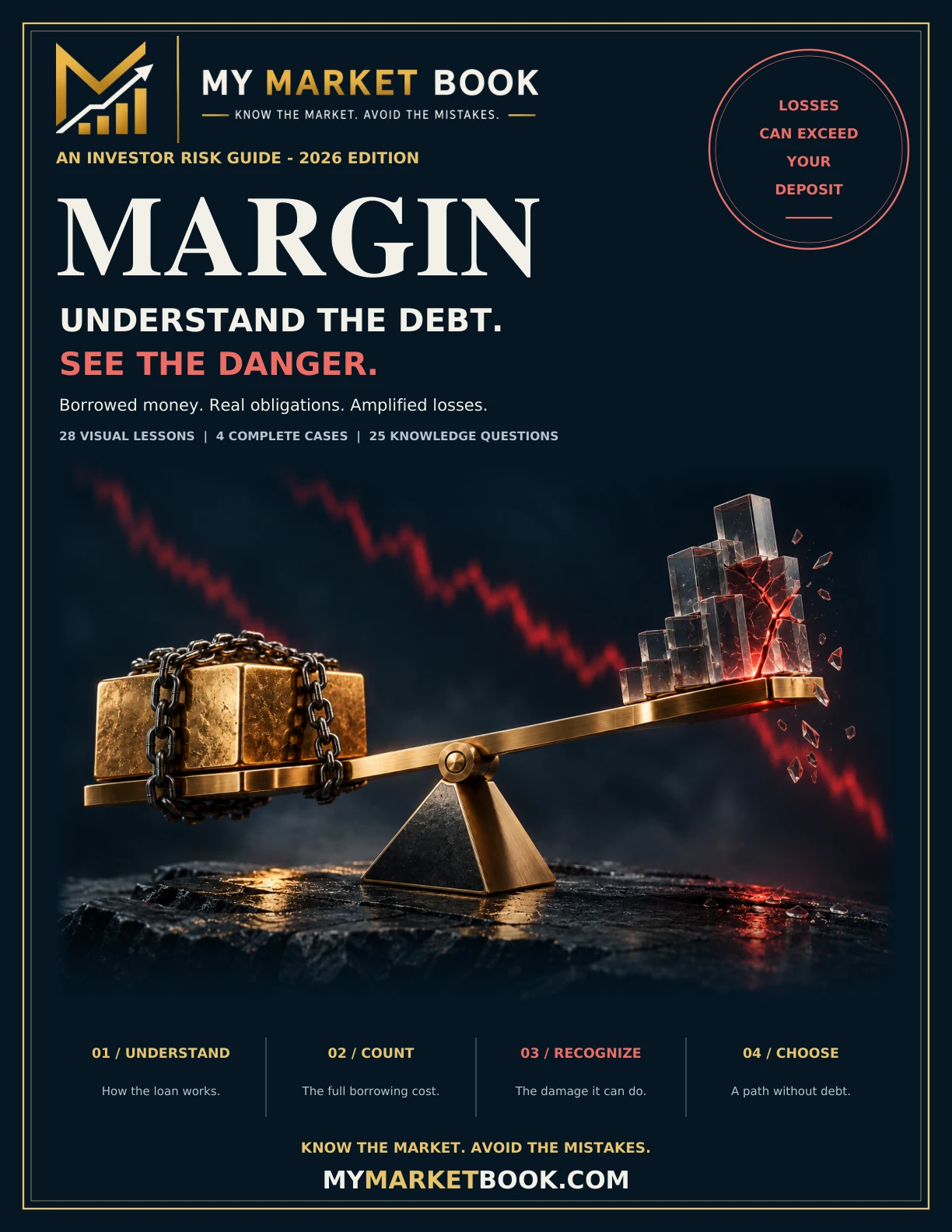
Borrowed money. Real obligations. Amplified losses.
Look inside $14.99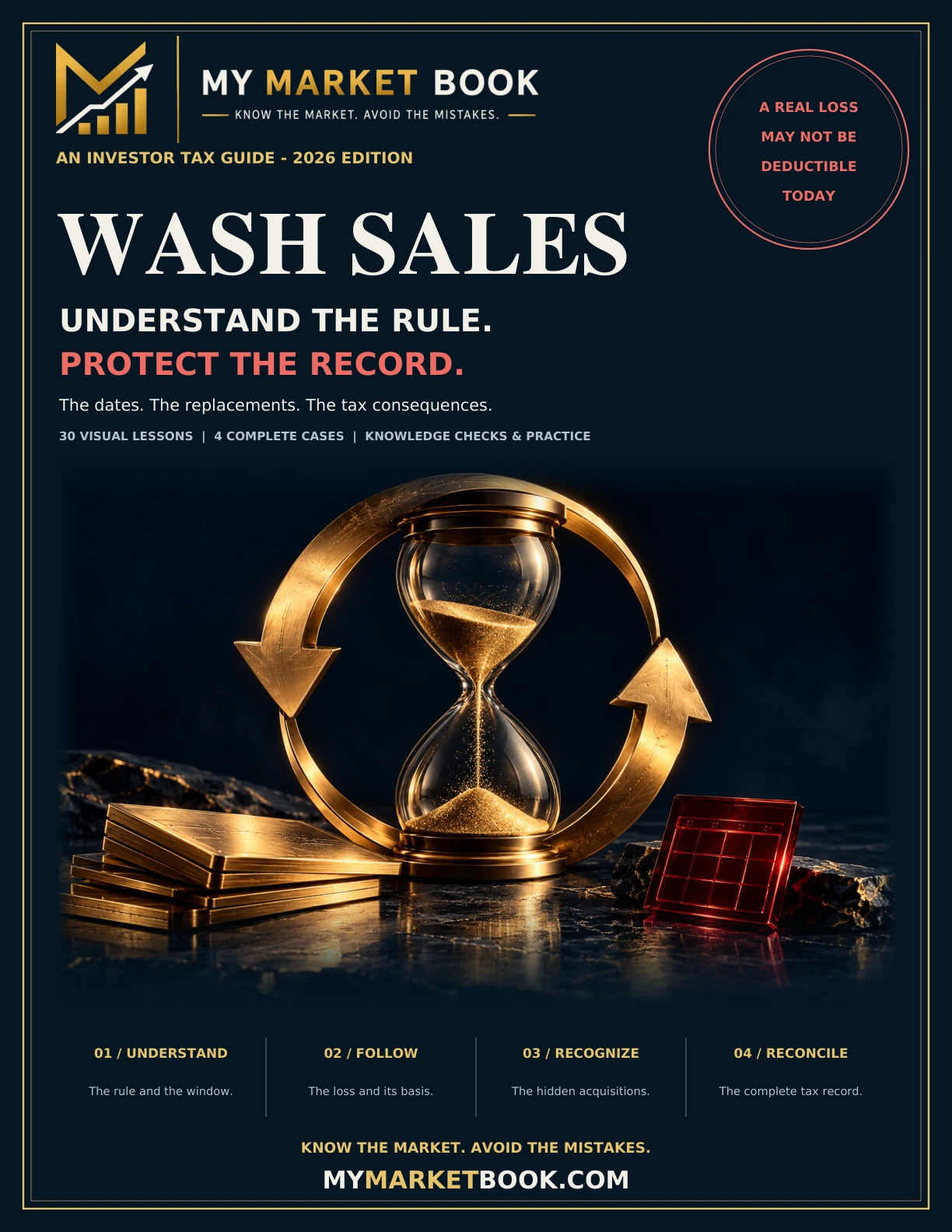
The dates. The replacements. The tax consequences.
Look inside $14.99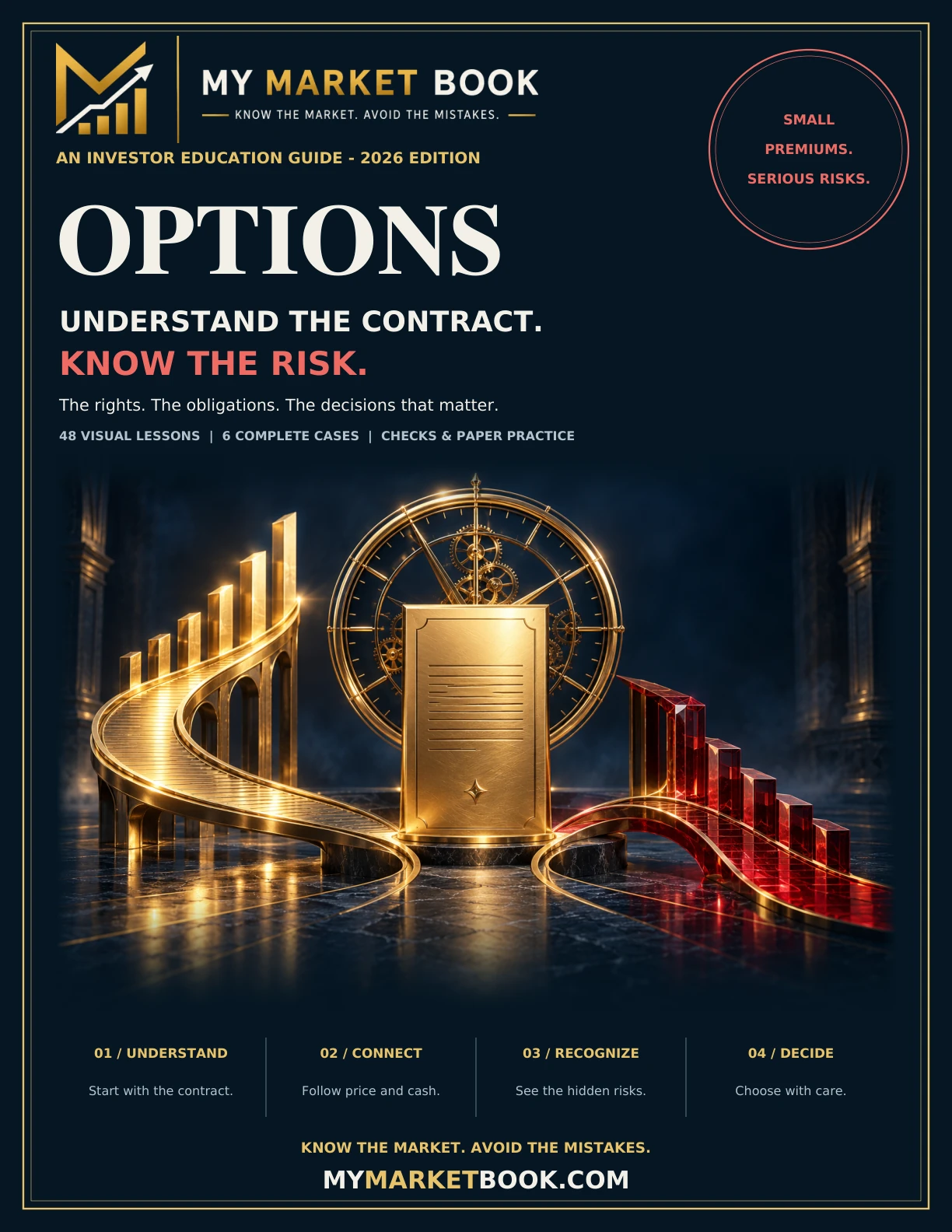
The rights. The obligations. The decisions that matter.
Look inside $14.99Clarity before capital
See the whole picture. Give risk the attention it deserves. Build your own judgment, one useful step at a time.
Real pages. Clear diagrams. One connected idea at a time.
Read a free chapter02Build understanding across ownership, markets, returns and risk.
Explore the lessons03Put your assumptions into numbers. Compare the upside and downside.
Use a calculator04Test your reasoning and learn the explanation behind every answer.
Play & practice

